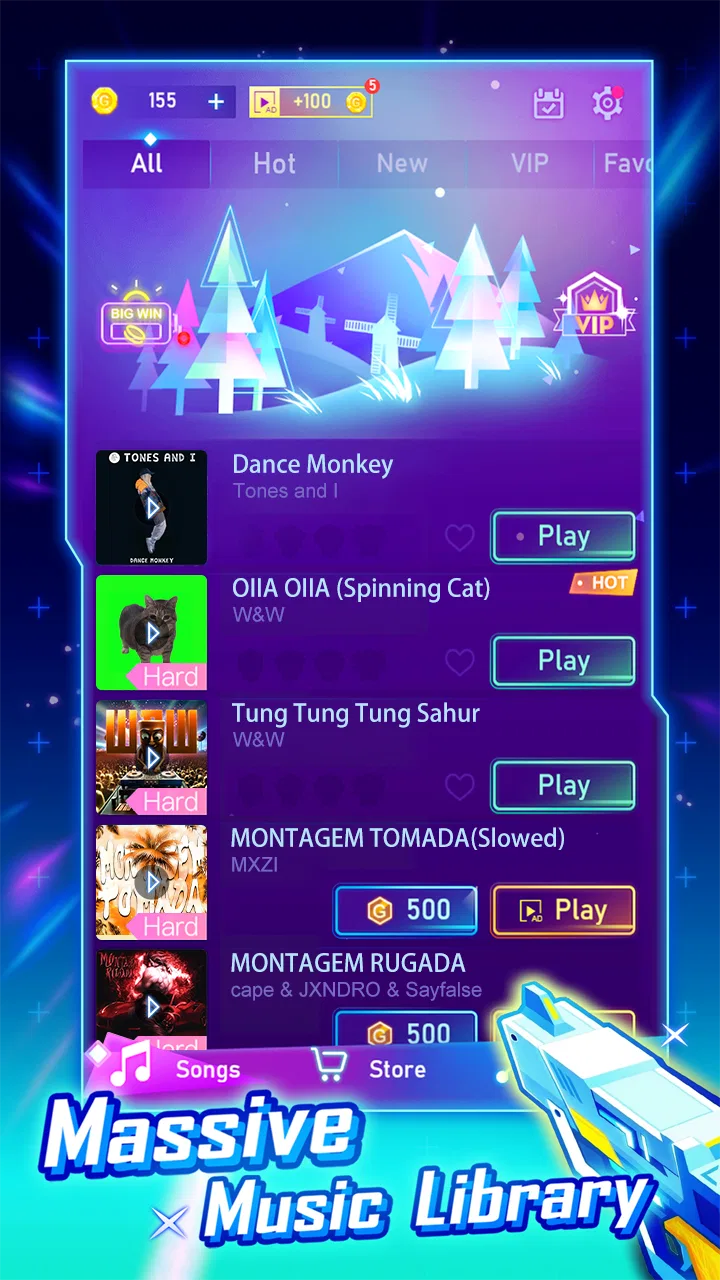
Beat Fire - Edm Gun Music Game
- 4.1
- Rating
- 50.00M
- Installs
- Free
- Price

 Analysis by App-foxy
Beat Fire - Edm Gun Music Game is the kind of mobile game I open when I want something quick, energetic, and easy to understand without committing to a long session. I tap to the beat, aim at incoming music tiles, and try to keep the rhythm alive. The idea is simple, but the combination of electronic music, visual timing, and shooting-style controls gives it more tension than a standard tap-along game.
After spending time with it, I see a clear audience for this music game: players who enjoy rhythm challenges but want something more active than simply pressing notes as they pass a line. It is free to start, made by Adaric Music, and carries a Teen content rating. Its current version is 2.0.1, while the game originally appeared on November 5, 2019. That history matters because this is not a brand-new experiment; it is an established title that has had time to settle into its particular style.
How Beat Fire feels in everyday play
The central loop is immediately readable. Music plays, tiles appear in time with it, and I use the gun-like interaction to hit them. The satisfaction comes from matching the soundtrack rather than randomly tapping the screen. When I find the rhythm, the game feels smooth and almost automatic; when I lose concentration, the same sequence can suddenly feel much harder.
You May Also Like

 AccuWeather: Weather Radar
AccuWeather Review: A Quick, Clear Forecast for Everyday Decisions
For everyday plans, the best forecast is the one you can understand quickly. AccuWeather makes rain timing, radar, and local conditions easy to act on, with a few trade-offs.

 Hill Climb Racing
Why Hill Climb Racing Still Turns Crashes Into One More Run
A tiny car, a bumpy hill and one more upgrade: Hill Climb Racing keeps resurfacing because its simple chaos makes every near-miss feel personal.

 AliExpress - Shopping App
AliExpress Makes Global Shopping Feel Personal, but Shoppers Bear the Risk
AliExpress turns a global marketplace into a pocket-sized discovery engine. Its reach is useful, its shopping loop compelling, and its trade-offs easy to miss.

 Lords Mobile: Kingdom Wars
Lords Mobile Is a Kingdom-Building Routine, Not a Quick Match
A case-by-case verdict on the building, battles, device demands, and social commitments that make Lords Mobile rewarding for some players and exhausting for others.

 PDF Scanner app - TapScanner
TapScanner Makes Paperwork Easier to Capture, Check, and Share
TapScanner makes scanning with a phone feel less like a rescue operation and more like a dependable step in getting work done. Its capture tools are useful, though not flawless.

 Block Blast!
 Shows How Much a Puzzle Game Can Leave Out
A quiet grid game shows why puzzle players increasingly value instant clarity, repeatable skill and low-pressure play—and where the genre still needs to catch up.
More From Our News Desk
View All News


I like that the game does not require a lengthy tutorial to explain its basic purpose. A short session is enough to understand the relationship between the song, the moving targets, and the score. That makes it a useful choice for a bus ride, a short break, or a few minutes before bed, although the energetic presentation may be less suitable if I am looking for something calming.
The shooting theme changes the mood without turning the game into a conventional action title. I am not exploring a map or managing weapons in the usual sense. The “gun” is mainly a rhythmic input, so the real skill is timing. This distinction is important: anyone expecting a full shooting game may find the concept lightweight, while anyone seeking a fresh rhythm format will probably understand the appeal quickly.
The best moments come when I stop watching each tile as an isolated object and start following the musical pattern. Repeated beats become easier to anticipate, while sudden changes demand attention. I found that playing with a steady posture helps more than frantic tapping. Keeping the device still and using consistent finger movements makes the timing feel more controlled.
A practical way to play better
One useful habit is to listen to a section of a song before trying to chase a high score. Instead of reacting to every target at the last possible instant, I pay attention to the pulse and prepare for the next group. This is especially helpful when the visual effects become busy. The game rewards concentration, but it also rewards learning how a particular track is structured.
I also recommend treating the first attempt as a practice run. Trying to play perfectly from the beginning can make a missed tile feel more disruptive than it really is. On a second attempt, I usually remember where the rhythm changes and can focus on recovering rather than panicking. That approach makes the game feel less like a test and more like a song I am gradually learning.
Another small but meaningful trade-off is sound level. With the music low or muted, the game becomes much more dependent on visual timing and feels less natural. With headphones or a clear speaker, the beat is easier to follow, but the energetic soundtrack may not suit every environment. I would use headphones in a noisy place, while keeping the volume moderate during longer sessions.
What the current edition tells me
The current version, 2.0.1, presents Beat Fire as a mature, focused experience rather than a game trying to cover every type of rhythm play. The core identity remains easy to recognize: electronic music, target timing, and a shooting-inspired presentation. I appreciate that clarity because the game does not need a complicated collection of systems to make a short session enjoyable.
Its popularity also gives useful context. The game has passed 50 million installs and holds an average rating of 4.1 from around 326 thousand ratings, with roughly 6.8 thousand written reviews. Those figures suggest that the basic formula works for a large audience, while the rating also hints that it is not universally perfect. In my experience, that balance makes sense: the game is accessible and catchy, but its appeal depends heavily on whether the player enjoys its particular presentation and music-driven repetition.
The update history should be viewed realistically. A newer version number can indicate ongoing maintenance, but it does not automatically mean the game has been transformed into something completely different. I would approach this edition as a refined version of the same compact rhythm concept, not as a replacement for a fully featured music platform or a deep action game.
How existing players may experience the evolution
For someone returning after a long break, the most noticeable benefit is likely familiarity. The central controls are straightforward enough that I do not need to relearn an elaborate system. That makes it easy to return for a few songs without feeling lost. At the same time, returning players should not expect the change from an older version to erase the basic limitations of the format. If the original loop felt repetitive, a version update alone may not change that personal reaction.
New players benefit from the same simplicity. There is little friction between installing the game and understanding what to do. The challenge comes from accuracy and consistency, not from studying menus or building a complicated character. This makes it a good introduction to rhythm games for someone who likes pop or electronic music but has not played a traditional note-lane title before.
The game is free, but optional in-app purchases range from $0.99 to $19.99 per item. I would keep that in mind before treating it as a completely cost-free experience. A sensible approach is to play the available core loop first and decide whether the extra spending feels worthwhile. Players who dislike purchase prompts or who prefer one upfront payment may be more comfortable with a paid rhythm game that removes that kind of decision.
Where it stands beside other rhythm games
Compared with a traditional rhythm game built around lanes, Beat Fire feels more physical and immediate. I am aiming at targets rather than reading a line of notes in a fixed arrangement. That makes the first few minutes friendlier, especially for casual players. The trade-off is that players who enjoy complex note patterns, deep song charts, or highly technical progression may find a dedicated rhythm title more satisfying.
It also differs from ordinary music-listening apps because the soundtrack is not passive background audio. I have to respond to it. That gives even a short song a clear purpose, but it also means the experience depends on my willingness to concentrate. If I only want music while doing another task, this is the wrong category of app; the game asks for attention rather than quietly filling silence.
Against other quick arcade games, its strongest advantage is the connection between action and sound. A normal tapping game might offer speed and bright effects, but here the timing has a musical reason. Its weakness is the same focus: once I have played several similar rounds, the novelty can fade if I am not motivated by improving accuracy or discovering more music.
Who should install it, and who should skip it
I would recommend it to casual players who want a game that can be understood immediately, music fans who enjoy electronic beats, and rhythm newcomers who prefer a target-based interface over a conventional note highway. It is also a reasonable choice for short sessions because the concept does not demand a large time investment before it becomes enjoyable.
I would be more cautious about recommending it to players who need a rich narrative, strategic depth, or a realistic shooting experience. The weapon imagery is a presentation choice, not the foundation of a full combat system. Likewise, people who want a completely relaxed game may find the pressure of matching incoming tiles more tiring than entertaining.
The Teen rating is another reason parents and younger players should consider whether the presentation suits them. The game is built around shooting-style imagery, even though the interaction is tied to music rather than conventional combat. That distinction may matter to families deciding what belongs on a shared device.
Small frictions that affect the experience
The main limitation is repetition. The basic action is enjoyable, but it remains the same kind of action throughout a session: follow the beat and hit the targets. I can enjoy that focused design for a while, yet I would not use it as my only mobile game. Players who need constant changes in objectives may lose interest sooner than rhythm fans.
Another issue is the narrow relationship between success and concentration. If I am interrupted, distracted, or playing in a place where I cannot hear the music clearly, my performance suffers. That is not a flaw in the idea itself, but it makes the game less flexible than a puzzle that can be played silently or paused between small moves.
The free-to-play structure also deserves attention. Since purchases are available, I would avoid tapping through any purchase-related screen casually, especially if a child uses the device. The safest everyday workflow is simple: play without spending first, decide whether the game has earned a place in your routine, and only then consider optional items.
Device compatibility is fairly broad because the game supports Android 6.0 and later. That helps people using older phones, although the actual comfort of play can still depend on screen responsiveness, audio clarity, and how easily the device can keep the visual rhythm steady. For the best results, I would close demanding background apps and avoid playing while the phone is struggling with other tasks.
Three useful habits beyond the obvious tapping
First, I use the song itself as a timing guide instead of staring only at the targets. This reduces the feeling of chasing objects and helps me prepare for repeated patterns. It is a particularly useful adjustment for players who keep tapping too early because they are reacting to movement rather than listening.
Second, I separate improvement from entertainment. If I am tired, I play casually and accept mistakes. If I want a better result, I choose a quiet moment, use clear audio, and repeat the same track rather than constantly switching. That turns the game into a small practice routine and makes progress easier to notice.
Third, I treat the visual effects as information rather than decoration. When the screen becomes lively, I focus on the direction and spacing of the targets, then return my attention to the beat. This helps prevent a common mistake: watching the effects so closely that the musical timing disappears.
What I would like to see next
Future development would be most valuable if it strengthened variety without losing the immediate control scheme. I would like the experience to keep its quick entry point while giving committed players more reasons to return, such as greater musical contrast, more meaningful practice options, or clearer ways to measure improvement. Those are expectations, not promises, but they reflect where the current format has the most room to grow.
I would also watch how the game balances accessibility with challenge. Its broad appeal comes from being easy to understand, yet long-term players need enough depth to avoid feeling that every session is interchangeable. The best direction would preserve the friendly first impression while offering more demanding patterns for people who have mastered the basics.
For existing users, the practical question is whether the current version still makes the core loop enjoyable. If the answer is yes, 2.0.1 remains a convenient way to keep playing a familiar rhythm format. If the answer is no because the repetition already feels tiring, I would look toward a different music game rather than expecting a version number alone to solve the issue.
My final take
Beat Fire - Edm Gun Music Game succeeds because it turns a familiar rhythm challenge into something visually active and instantly understandable. I enjoy it most in short bursts, when I can hear the music clearly and give the targets my full attention. The shooting-inspired control makes the game stand out from standard tapping titles, while the electronic focus gives each round a strong sense of movement.
It is not the right choice for everyone. The loop can become repetitive, the Teen presentation will not suit every player, and optional purchases mean that “free” should be treated with awareness. Players seeking deep progression or a broad music library may prefer a more specialized alternative.
Still, I think it is worth trying if you want a free, approachable rhythm game that works well in small pockets of time. My recommendation is to start with a few sessions, use headphones when possible, and judge it by whether improving your timing feels satisfying. If the beat-and-target relationship clicks for you, this is an entertaining little game to keep around; if it does not, no amount of visual energy will make the simple loop feel deeper than it is.
FAQs for Beat Fire - Edm Gun Music Game
01What is the main objective of Beat Fire - EDM Gun Music Game?
Beat Fire - EDM Gun Music Game combines rhythm and shooting mechanics to create a unique gaming experience. The main objective is to shoot tiles on the screen to the beat of music tracks. Players must maintain accuracy and timing to achieve high scores, making it both a musical and strategic challenge.
02Is Beat Fire - EDM Gun Music Game suitable for all ages?
While Beat Fire is designed for a broad audience with its intuitive gameplay and catchy music, the game is best suited for players who enjoy rhythm-based challenges. The app includes vibrant graphics and straightforward controls that can appeal to younger players, though parental guidance might be necessary for in-app purchases.
03Are there any in-app purchases in Beat Fire - EDM Gun Music Game?
Yes, Beat Fire offers in-app purchases. Players can buy additional songs, remove ads, or purchase other game enhancements. These purchases can enhance the gaming experience but are not necessary to enjoy the basic gameplay. It's important for users, especially parents, to be aware of these options.
04Does Beat Fire - EDM Gun Music Game require an internet connection?
Beat Fire can be played offline, which is a great advantage for users who want to enjoy the game without an active internet connection. However, some features, like downloading new songs or accessing leaderboards, might require an internet connection for optimal functionality.
05How does the game handle music licensing and song availability?
Beat Fire includes a variety of EDM tracks that are licensed for use within the game. The developers frequently update the song library, providing players with fresh content. While popular tracks are included, the availability might vary, so users interested in specific songs should check for updates.
Pros
- Engaging rhythm-based gameplay.
- Variety of popular EDM tracks.
- Simple and intuitive controls.
- Visually appealing graphics.
- Regular updates with new content.
Cons
- Contains in-app purchases.
- Ads can disrupt gameplay.
- Limited offline functionality.
- Repetitive gameplay for some.
- Occasional lag on older devices.

Beat Fire - Edm Gun Music Game
Gallery